

Research Highlight
Emergent Universal Drag Law in a Model of Superflow
Can a small model tell us how a much larger system will behave?
In everyday fluids like air or water, there is a remarkable principle: if you scale an object up or down — from a toy airplane to a real aircraft, for example — the flow around it can remain the same when the relevant dimensionless parameters are matched.
This idea, known as dynamical similarity, is one of the reasons wind tunnels work. A small model can reproduce the behaviour of a full-sized aircraft, even though the two are very different in size.
Does the same idea work in a superfluid?
What makes superfluids different?
Superfluids can flow without ordinary viscosity, and the vortices they produce are fundamentally different from the swirling eddies found in everyday fluids.
Whether the familiar scaling laws of ordinary fluid dynamics could survive in this very different environment has been an open question.
A universal drag law
In this work, through using numerical simulations, I created the equivalent of a superfluid wind tunnel to investigate how turbulence develops as a superfluid flows past an obstacle.
Once the flow becomes turbulent and produces quantized vortices, the drag on the obstacle follows the same universal scaling behaviour found in classical fluids.
This provides evidence that dynamical similarity survives even when in the absence of viscosity and applies in superfluids as well.


An unexpected result
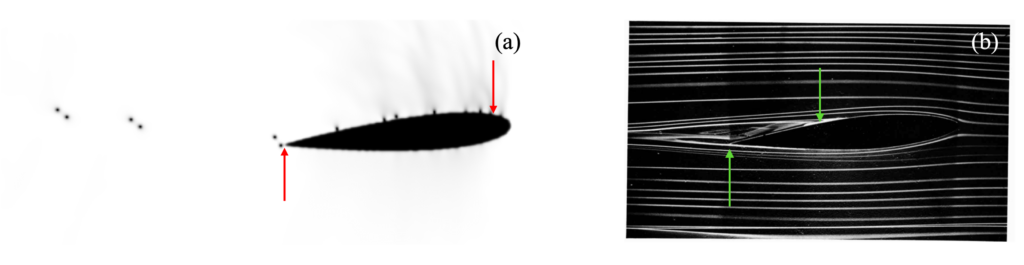
The simulations also reveal something rather counterintuitive: streamlined objects, such as airfoil-shaped obstacles, can generate substantially more turbulence in a superfluid than their classical counterparts. We believe the differences between the classical and superfluid drag coefficients – particularly for the airfoil – are due to the absence of a viscous boundary layer. We a see a significant difference between the boundary separation of a vortex in a classical airfoil versus its quantum counterpart.
Why is this useful?
The result suggests that the superfluid Reynolds number provides a general way of comparing turbulent flows at different scales. If the drag is scale-invariant under this parameter, other dimensionless quantities describing the flow should be as well.
This gives us a useful framework for studying turbulence in superfluids: rather than treating each experimental system and length scale separately, we can use the superfluid Reynolds number to compare them. It also opens the door to looking for superfluid counterparts of other classical phenomena that depend on the Reynolds number, such as the drag crisis.
More broadly, this suggests that superfluids can provide a new experimental setting for studying some of the fundamental features of turbulence. Because superfluid vortices are quantized and can be directly observed and controlled, they offer a way to investigate aspects of turbulent flow that remain difficult to isolate in classical fluids.